Showing posts with label DIY. Show all posts

Friday, January 27, 2017

DIY Winter Wreath

I'm getting to that point in my adult life where I hate to see a "naked" front door (I'm assuming every woman gets to that point, right? No, just me?). I used to be a simple Christmas wreath type of gal, but I've become a believer in wreaths adorning my front door year-round. At this point, I'm sticking to seasonal wreaths, and I was missing a winter variety, so I got to work last Sunday and whipped one up! It's super easy, and as long as you've got a hot glue gun and a craft store near by (or some extra craft materials), you can make one this weekend, too!

**This type of wreath isn't recommended for front doors that are exposed to the elements (meaning not covered by a roof for a stoop or porch). If you don't have a covered front door, you could always hang this inside your house instead!


What you'll need:

  • one foam wreath in a size of your choice (I used 16 inch, which I think was a good size for a standard front door wreath)
  • fabric (I had some sparkly burlap lying around, so I used that instead)
  • faux flowers
  • hot glue gun and glue sticks

I found these cute bouquets/bunches of flowers, and they were on sale!

What you'll do:

1. Lay your wreath on top of your fabric and cut the fabric to size. Be sure to leave enough to wrap around the wreath fully and glue on the backside. 


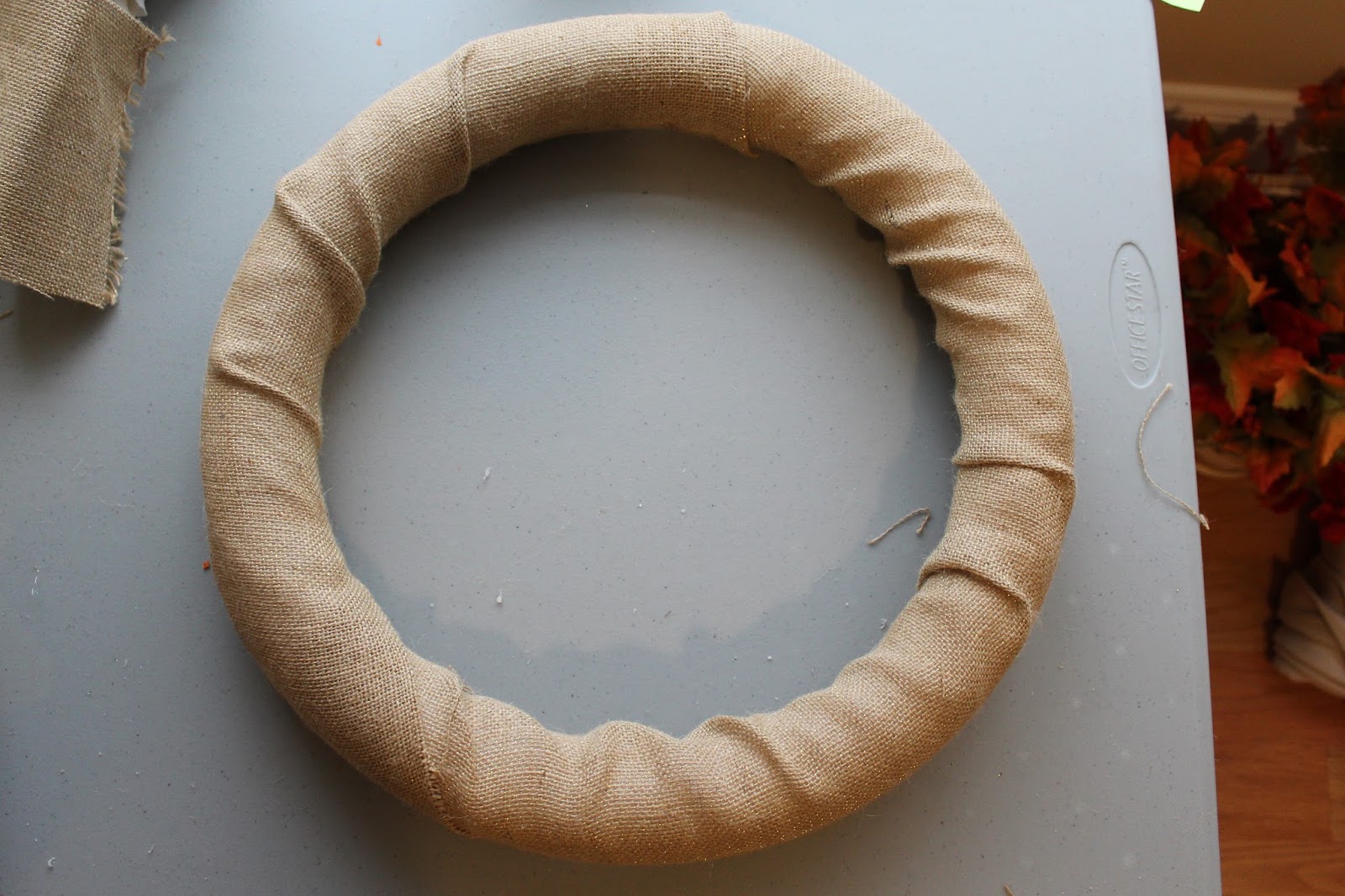
2. Wrap your fabric around the foam and glue in place. I wrapped around the outside first and glued. Continue until you have wrapped around the outside of the entire wreath, and try to glue in the same space on the back of the wreath. I had to use two strips of burlap to cover my wreath, so I had to do some planning to ensure the edges met neatly.


3. Before you begin gluing the fabric that will come through the inside of the wreath, turn the wreath over and look at it from the front side to get an idea of how it will look. The fabric will inevitably bunch in some places, so make sure you like it before you glue it in place. Then glue the fabric to the back of the wreath.


4. After your wreath is wrapped completely, gather your flowers and pull them off the stems/bunches. For a more organic look, include some greenery, as well.


5. Arrange your greenery first, then glue in place. Place the leaves so they will peek out around the sides of the wreath, otherwise you might not see them after you glue on the flowers. I like to keep my flowers on just a third of the wreath, so I kept that in mind as I arranged the leaves.


6. Now it's time to add your flowers! Use A LOT of glue to ensure they stay put once you attach them (start-to-finish, I went through 3.5 glue sticks). Hold the flower in place for a bit after you apply the glue to be sure it catches and dries a bit.


7. Hang your wreath and admire your handwork! You can use a wreath hanger, or try out my wreath-hanging hack: install an upside-down Command Hook inside, near the top of your door. Then loop some ribbon or fishing wire around the wreath and over the top of the door. Secure it to your Command Hook inside with a knot. (click here for a visual)


I love how this turned out. I wanted the bright whites and soft pinks and greens, and the burlap adds a perfect rustic touch.

I hope you have a lovely, possibly crafty weekend!

Thursday, September 8, 2016

DIY Stain Remover

I am admittedly the furthest thing from a laundry goddess. I wait till the last possible second to do a load of laundry (meaning the kids are out of clean pajamas or I'm out of undies or hubby's out of socks/work shirts). I need to be better about doing a load a day instead of trying to cram all the dirty laundry in the house into the machines on the same day. 

Naturally, I am also not very good at getting stains out of clothes unless they're super easy surface stains that a quick squirt of Shout can handle.  I've never had much luck with OxiClean either (perhaps I'm not doing it right???). My mother-in-law swears by the power of baby powder to get out greasy/oily stains but I still haven't had it work for me. I've even thrown away some of Max's old onesies if I couldn't get stains out easily.

Now that Max is eating all kinds of foods and making big messes while doing so (bibs can only protect so much), I'm not willing to throw out every single shirt of his when the stains won't come out, so I went searching for a DIY stain removal remedy. I've tried a few different ones, but this one I'm sharing today has been the most effective, especially at getting out breastfed-baby poop stains.

DIY Stain Remover

What you'll need:
  • hydrogen peroxide
  • baking soda
  • Dawn dish soap (although I'm sure any would work)
  • bowl and spoon for mixing
  • soft bristle brush


What You'll Do:
  1. You will need to use one part baking soda and one part dish soap to two parts peroxide. You can adjust how much you make based on how many stains you need to treat. I generally do a tablespoon each of baking soda and Dawn with two tablespoons of hydrogen peroxide and I have plenty for several articles of clothing.
  2. Measure and mix your ingredients until you have a smooth liquidy paste (no better way to describe it).
  3. Spoon out the mixture onto your stains. I always treat the side where the stain occurred, so for diaper stains, I treat the inside of the garment. You can use the spoon to rub the mixture into the stains, or use a soft bristle brush to pat the mixture into the stain (don't scrub or you'll cause the fabric to pill).
  4. Let sit for at least an hour (I feel that 2 hours is best), then wash normally. Your stains should have come out! If not, they will at least be faded considerably, and another treatment should remove them completely.


A little graphic but this is life with a baby!


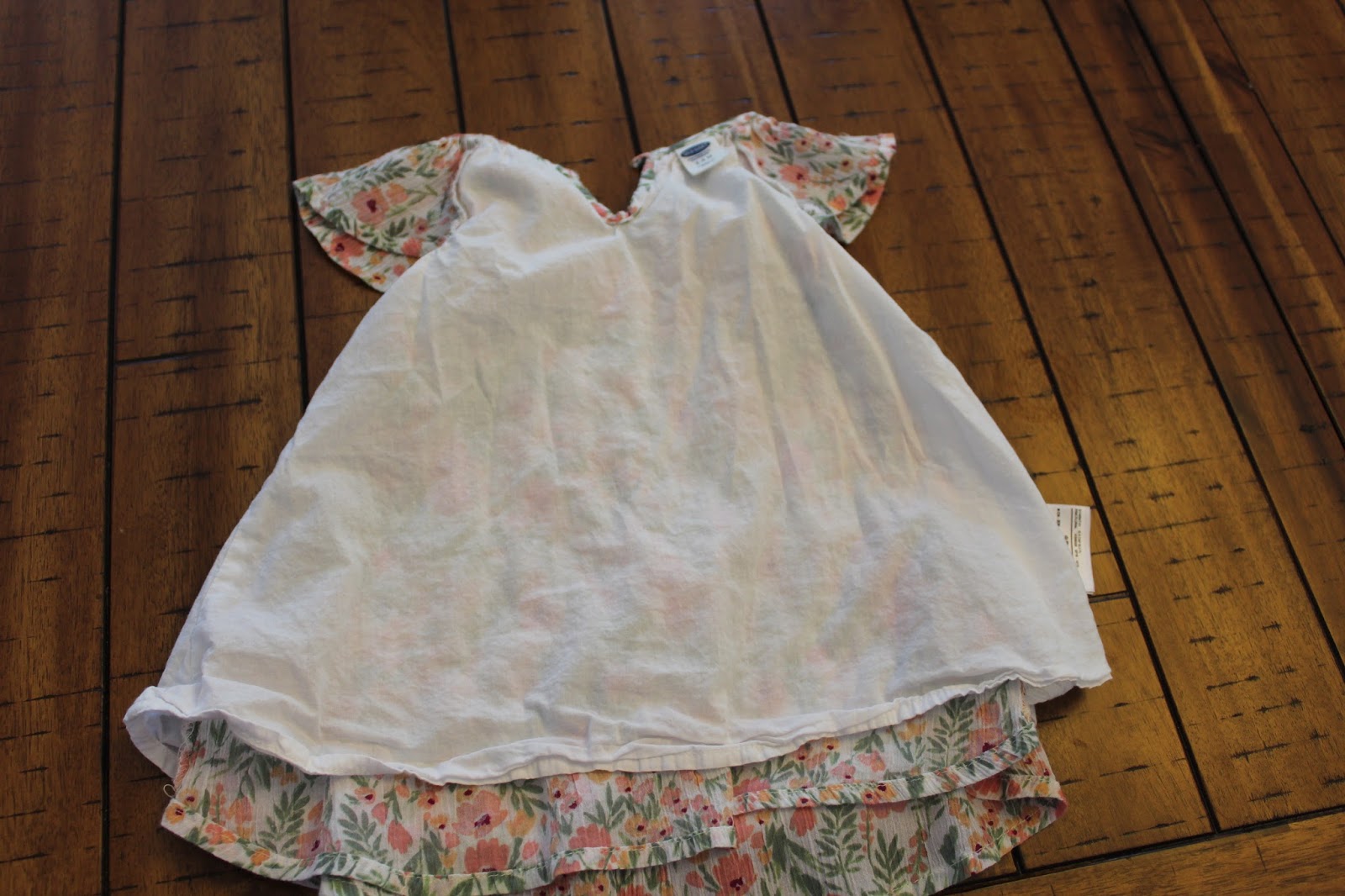
I rinsed off the dried on stuff before treating this dress

A few leakage spots on this onesie

As mentioned before, I have had great luck with getting baby poo stains out of clothes. Louisa had a blowout all over both of us last week, but I wasn't worried because I knew this concoction would do the trick, and it did!


Some of you may be worried about using hydrogen peroxide on non-white clothing due to its bleaching effects. I have used this on many different colors of fabric (I believe they've all been cotton so I can't attest to other fabrics) and it has not compromised the color at all. That's not to say it won't in the future, but so far I haven't had any problems.

One type of clothing it wouldn't work on was a screen-printed beach scene on one of Max's shirts, The paint-like substance on the shirt made it tough to really get at the stain on the bits of exposed fabric, so the stain didn't come out well there.

I have used this on set-in stains, even clothes that have been washed and dried many times over, and it still worked to diminish the stain, if not removed it entirely!

It's not recommended to pre-mix this and store it for future use since the hydrogen peroxide breaks down once it's exposed to light (hence the brown bottles), which makes it less effective. I've found that if I just set aside clothing items that need to be stain-treated throughout the week, I can easily mix this up, treat them, let them sit, and then wash them all at once and it works great! 

Hope this helps bring your kids' clothes back to their original glory!

Wednesday, March 30, 2016

DIY Wooden Photo


I came across a tutorial for DIY wooden photos on Pinterest years ago, and I was immediately excited to create my own; I love wooden decorative objects, and I think it's so cool to see the woodgrain come through the photos when you transfer them. The first wooden photo I made was a photo of my mom, sister, and me in Central Park back in 2012 (I learned the hard way that I needed to flip the photo before printing it that time). Then I made some wedding gifts for darling Nelle at simply love. I also put a couple of our engagement photos on wood for my in-laws. I think I had planned to make some wooden wedding photos for our house, but I must've forgotten over the past 2.5 years. #oops

I used a wooden plaque from Michaels for this first attempt a few years ago.


After racking my brain trying to think of a good gift-from-Max idea for my father-in-law's birthday, I decided to make a wooden photo for him! I documented the process of making this gift so I could share it with you in case you wanted to try your hand at this, as well!

A few warnings before you decide to take this on yourself:
  • The gel medium is a little pricey (an 8 oz. jar costs $15.99, but you can find cheaper ones online), so make sure you want to do this a couple of times to get your money's worth. The good news is, I bought my jar of gel medium in late 2012/early 2013 and it's still good today.
  • The best way to get more bang for your buck is to get raw wood from your local hardware store (you can have them cut it for you, too!). I bought a 2in. by 6in. by 8ft. piece of pine a couple of years ago and had it cut into 8-inch lengths, giving me a stack of wooden blocks to have on hand any time the mood would strike to make a wooden photo. This is much cheaper than purchasing wooden plaques from your local craft store.
If you're still not scared away, here we go!

What you'll need:
  • An untreated wooden surface (either a wooden plaque or a piece of lumber)
  • A photo printed on regular paper (I've only done this in black and white) **be sure to "flip horizontally" on your computer before printing
  • Gel medium
  • Paint brush or foam brush
  • business card or gift card
  • Water and sponge/cloth
  • Mod Podge
  • Optional: acrylic paint

What you'll do:
  1. Print your photo's mirror image on regular printer paper in the size you prefer. You could have your photo take up the entire surface of your wooden piece, or make it smaller. (My wooden piece was 6.5 inches by 8 inches, and my photo was 4 inches by 6 inches.) Trim off the excess paper.
  2. Using your foam brush or paint brush, apply a thick layer of gel medium to your wooden surface. Be sure the entire surface has a good amount of the gel on it, otherwise your photo won't transfer well (I've seen other tutorials which brush the gel medium directly onto the photo). Immediately place your printed photo face down onto the gel. 
    You want much more than this on your surface.


  3. Using a business card or gift card, smooth out any bumps or bubbles. Allow to sit overnight to dry.
  4. The next day, use a sponge or cloth and some warm water to saturate the paper, then use your hands to gently rub away the paper. The color from your photo will be "stuck" to the wood underneath. You may need to re-wet the surface and repeatedly rub to get all of the paper off. My advice is to work in small quadrants, wetting only a small area at a time to rub. 

  5. Once you have removed all of the paper, wipe the surface with a dry cloth and allow wood to dry. 

    This is the photo I added to the back.
  6. If preferred, you can use acrylic paint to paint around the edges of your photo. Since this was a gift from Max, I wanted him to have a hand in its creation, so we painted. If you do not wish to paint, skip to step 7. 
  7. After your surface is dry, brush on one or two coats of your preferred finish of Mod Podge (I used "Satin") to seal the photo. Allow to dry completely before handling.


This is a cool twist on a photo gift or keepsake for your home. The end product has a lot of character and looks so unique!


Max was so excited to give this project to his Vovo for his birthday last weekend. He couldn't wait to help him open it and show him what he made!


Wednesday, March 9, 2016

DIY Photo Board


I've been on the hunt for a photo board for baby girl's room. Max has one in his room, and I love showcasing photos of him with the important people in his life. It's an easily-swapped display for his room, and he loves naming all the special people in the photos. Finding Max's board was easy--it was mine in college and fit his color scheme perfectly; unfortunately, I haven't had much luck in finding the exact style I'm looking for to place in his sister's room. I've searched in stores and online and nothing is striking my fancy.

Max's board in his room. I bought this at Target years ago. Or maybe Walmart.

Naturally, I Googled how to DIY your own photo board, and after exploring a few different options, I settled on the procedure outlined below. This is super easy to whip up (I created mine during the first half of naptime on Monday), and it's so easy to customize. Plus, you likely have a good portion of the materials already at home!

DIY Photo Board

Materials:


  • Art canvas with wooden frame in the size of your choice (I used 18x24 inch)
  • Fabric of your choice. You want to have at least 6 inches of overlap around the edges of your canvas. I had this burlap lying around, so I used that.
  • Quilt batting (again, allow for at least 6 inches of overlap around the canvas edge)
  • Coordinating ribbon (I used 5/8 inch non-stretchy ribbon on a 10 yard spool and had plenty leftover)
  • 5 decorative buttons
  • A staple gun
  • Scissors
  • Needle and thread (depending on the type of button you choose, you may want to have coordinating thread color to match your fabric)
Directions:
  1. Iron your fabric, if needed, then lie it right side down on your crafting surface. Then layer your quilt batting over it (you can use two layers of batting if you'd like to create a more cushion-y look, but I found that just one layer was fine). Last, lie your canvas, front side down, on top of your fabric and batting. 
  2. Pulling the fabric/batting tightly around the back edge of the canvas, staple all around the edges of the canvas. The more staples, the better! I've found it's best to start in the middle and work your way to the edges.

  3. The corners can be tricky. I just folded and stapled, folded and stapled some more, until the corners looked like the photo below. Check the front of the canvas to make sure it all looks nice. 
  4. Trim off the excess fabric and batting on the back once everything is stapled.
  5. Beginning in one corner--still on the back--of the canvas, staple the end of your ribbon a couple of times, then string it around the front of the canvas, diagonally across the front, and staple again on the back side of the opposite corner (for example, begin on the top left and end on the bottom right). Repeat with the other corners. You're basically making a big X on the canvas.
  6. Continue stapling your ribbon on the back of the canvas and crossing the ribbon over the front to create the pattern below. You don't need to be exact; I eyeballed it, but you could measure the halfway points of each side if you want to. 

  7. Now comes the most tedious part: sewing the buttons. The buttons will go where the ribbons overlap. Sew the button tightly into the fabric/batting/canvas. The middle button will be tricky due to the cross bar in the back, but it's manageable. 
  8. Choose a length of ribbon to staple in the top corners of your board (on the back!), beginning in one corner and ending in the other, for hanging purposes.


Now all that's left is choosing your favorite photos to display in your pretty photo board! I love using these in kids' rooms because there's no need for magnets or thumbtacks--it's baby-proofed already!


Wednesday, February 17, 2016

The Making of a Nightstand for Baby Girl

I am so happy to announce that I am FINALLY FINISHED with this nightstand, and it turned out just as I dreamed! I'm so glad I went the DIY route with this one. It was most definitely a labor of love, and it came with quite a few challenges, but I feel a great sense of pride knowing that I created it for my baby girl.


I didn't always know I'd use this particular table for a nursery nightstand, though. In fact, when Victor and I went to IKEA a couple of weeks ago to get another Hemnes dresser for Max's new room, I was also on the hunt for a cute little nightstand/side table for the baby's room. I considered getting one that matched the dresser, but since it was $99, I figured I could find a cheaper option. I found Max's nightstand at the local vintage barn that I love so much for $45, and I loved the look of it. Another chalk-painted piece seemed fitting, so I thought I could try to find something at the barn.


Then I remembered that my late maternal grandmother's old sewing machine table was just collecting dust in a spare bedroom. It needed some serious TLC, but it could be beautiful again.
The top was in really rough shape.
With my mother's blessing, I decided to chalk paint it myself. I've never used chalk paint before, but one of my aunts is a chalk painting pro (for realz, she has a cute little shop in Cincinnati where she refurbishes old furniture. She's quite talented), so I consulted her for advice. I decided to use the brand of paint she sells in her shop, Chalk Country Paint, and she helped me find the perfect color I was looking for: a light, minty green. "It's Jade" was the one I decided on, and she shipped it out to me.


As I waited for the paint to arrive, I got to work prepping the table. It's super old--so old that my mom remembers it in their house when she was a kid. I needed to remove the hinges and take off the flap-style flip-up doors, which proved to be quite difficult. I tried to no avail to get the ancient screws out of those hinges. Then Victor came home and removed them without breaking a sweat (likely because I had already loosened the screws for him...). One of the hinges was missing a pin, so I found similar hinges at Home Depot, but it turned out they weren't the right width, so I couldn't use them. I took off the table top, as well, as it was missing a screw. I wiped everything down with a damp cloth in preparation for painting, then set up shop in the basement (I normally would've done this project in the garage, but it was so cold outside that I couldn't bear it).

Chalk painting is nice because you don't need to do any real prep work before you begin painting other than a good wipe-down of the piece. No sanding or priming required. I quickly added the first coat on Saturday during nap time.


I swung by Home Depot on Sunday to find new knobs and some sort of solution to the missing hinge pin dilemma. Victor and I thought of using a nail to serve as the pin, but we later decided that wouldn't work since the hinge sits up and away from the table and the nail could slide out. I needed something that fit snugly. I thought some thick wire would work, so I hung out in the picture-hanging aisle and shoved various gauges of wire into the hinge (so important to bring your stuff with you to help shop!). A 14-gauge wire fit the bill! I came home, changed my clothes, and got to work adding the second coat of paint, and I also cut some wire to fit into the hinge and put it into place. It worked perfectly!


On Monday after playing in the snow, I lightly sanded the entire piece using a 220-grit sanding block, then dusted it with a dry cloth. 


I did some Googling to figure out how to clean off the hinges; they were all completely tarnished and looked almost black, but in a few places I could see some hints of brass peeking through, so I knew they could be pretty again. I first tried a paste of baking soda and vinegar, which sort of worked, but then another trip to Google suggested just plain vinegar. After a few hours of soaking and some serious scrubbing with a metal brush, the hinges looked good as new!

Nicole Curtis of Rehab Addict would be proud!

Unfortunately, the screws didn't fare so well. It turns out they were not made of brass like the hinges, and they totally rusted out after being soaked and scrubbed. 

On Tuesday during naptime, I waxed all surfaces of the table and its components using Minwax Paste Finishing Wax (Chalk Country Paint has their own recommended brand of wax, but my aunt said I could save a little money and use Minwax and get the same result). I decided to do two coats of wax since the first coat was a little streaky. I simply used a foam sponge to apply the wax, then once it was dry, buffed it with a soft dry cloth. It left a nice, satiny finish.


After naptime on Tuesday, Max and I headed to "the tool store" (aka Home Depot) to return the knobs i bought on Sunday/search for smaller ones and find some new tabletop and hinge screws. We were armed with some original rusty screws and one of the table's doors to help with comparisons and sizing. I still had the new sets of hinges that I had previously bought and decided that if I couldn't find anything else that would work or if the prices didn't match up, I'd just use the screws from those hinge packs. Max and I found some cute glass knobs and some perfect screws for the tabletop. I found some screws for the hinges that would work, but they came in packs of 6 and I needed 16 screws. Instead of waiting to return the hinges and purchasing 3 packs of screws, we headed home with the hinge packs (which had exactly 16 screws).

After Max went to bed on Tuesday, Victor helped me reassemble the table. We hit quite a few unexpected roadblocks at this point in the project:
  • The screws for the knobs were too long for the doors. Luckily I have a handy husband, and he used some heavy-duty wire/bolt cutters to cut them to size. 
  • The screws from the new hinge packs were slightly longer than the original screws (which I was aware of), and two of the screws poked through the top of the wood on the table (they worked fine in the doors). We removed those screws and decided to use the old rusted ones (after I wiped them off with a cloth, which helped a little. I Googled how to remove rust from metal, and one popular suggestion was to use vinegar. Since vinegar was what caused the rust in the first place, I opted against that solution).
  • When we were attaching the last couple of hinges, we realized we were missing a screw! To troubleshoot, we used a screw from one of the original wooden knobs, which was slightly bigger and longer than the hinge screws and was difficult to install--it later broke in the hinge! Luckily the coats of paint on the doors helped hold the hinges in snugly, so a missing screw wasn't the end of the world.
  • As I was attempting to add the last screw to the last hinge, we learned that a screw must've broken off in that hole since I couldn't get the screw into the table--so a wasted effort was made in replacing the screw in the first place!
  • When it came time to attach the table top, the screw wasn't attaching well to the tabletop in one location due to the fact that the tabletop was warped, so we shifted the top over a bit and made new contact points with the tabletop.


Finally, after about 45 minutes (I was expecting the reassembly process to take close to 10 with no snafus), the table was completely reassembled and she looked divine!


Admittedly, this is not a project I would typically take on. I like projects that can be done from start to finish in one sitting. This one took 4 days. That's a monster test of my patience. Had I not needed to work around nap schedules and such, I probably could have done it all in 2 days. I give a lot of credit to the people who do this process on huge pieces! Needing to remove old hardware made this project a bit more difficult than I anticipated, so perhaps a future project with no disassembly/reassembly required will be less time consuming.

In the end, I'm glad I took this on and came across a few issues in the process. Being a stay-at-home mom is rewarding and challenging in itself, but it was nice to be challenged in a different way and be able to use my problem-solving skills.

Doesn't that gold Target lamp just look precious on that sweet table?